What Is a Hydraulic Bottle Jack Used For? Best Jobs and Limits
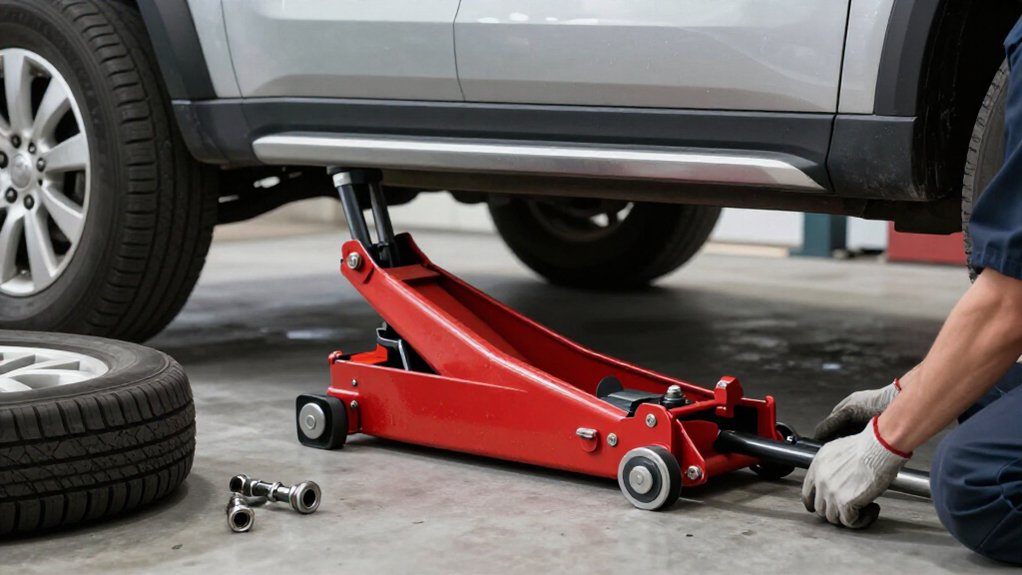
A hydraulic bottle jack uses pressurized oil to lift trucks, trailers, and machinery for wheel, brake, or axle work.
You pump the handle to raise the saddle, but lifting stops at the jack’s stroke limit.
Choose a rated capacity above the load, place the jack on firm, level ground, and use only reinforced lifting points.
Never work beneath a vehicle supported only by the jack; transfer the load to rated stands.
You’ll also want to know its key limits.
Truck and Trailer Lifting Jobs
When you need to change a truck tire, remove a wheel, or replace a brake component roadside, a hydraulic bottle jack offers compact, portable lifting that fits easily in a toolbox. A bottle jack works well for straight-up lifting to low-to-moderate heights when you don’t need a floor jack’s long reach. Check the model’s rated lift range; some reach about 17-3/8 inches.
Position it only beneath reinforced lifting points, such as frame rails or suitable axle areas. Never lift from plastic bumpers, body panels, or suspension parts. Choose a capacity above the load on the truck or axle you’re raising, and leave a safety margin rather than routinely working at the limit. On gravel or soft ground, place a thick steel plate under the base; use plywood with a steel plate if needed to limit sinking or shifting. Support the vehicle with properly rated stands before working beneath it. Check footing first.
Hydraulic Pressure Basics
As you pump a hydraulic bottle jack, pressurized fluid pushes the piston and saddle upward to lift the load.
You build pressure with each pump stroke, and the piston’s travel determines how far the jack rises. Pressure continues lifting only until the piston reaches its stroke limit; it can’t provide more extension beyond that point.
The cylinder must hold fluid pressure. A leak or dirt or water in the fluid can weaken performance and make lowering under load slower or less predictable. When you open the release valve, pressure bleeds back to the reservoir, allowing a controlled descent. Check the jack’s rating before use: a 20-ton jack is intended for loads up to that limit. Exceeding its design capacity can damage seals or cause failure.
Raising a Sagging Deck Beam
Use a hydraulic bottle jack to raise a sagging deck beam only at a reinforced lift point, never against thin decking or trim. Before lifting, check the jack’s rated capacity and center its saddle beneath the beam to prevent point loading. Set its base on a steel plate at least 1/2 inch thick, or a plywood-and-steel sandwich on soil or gravel, to resist sinking or slipping.
| Lift step | Your action | Safety reason |
|---|---|---|
| Raise | Work in small increments | Control movement |
| Stop | Near level; mind limited stroke | Avoid overextension |
| Support | Fit rated jack stands | Hold beam securely |
| Backup | Keep jack only as backup | Seals may leak |
Don’t rely on hydraulic pressure alone: seal wear can lower the jack slowly.
Stop if the beam shifts, cracks, or won’t rise evenly and safely.
Lifting Agricultural Machinery
For tractor maintenance or harvester repairs, use a bottle jack rated for the load and place it at a manual-approved lifting point. Set it on firm, level ground and keep the load centered on the saddle.
Before working underneath, lower the machine onto rated jack stands.
Tractor Maintenance
When servicing a tractor, a hydraulic bottle jack can lift one end for wheel changes, brake work, or undercarriage inspections. Choose a jack whose rated capacity exceeds the tractor’s weight at the lift point; a 20-ton (40,000-pound) model may suit some machines, but check the load. This prevents overloading the seals and hydraulic system.
Its compact, vertical design fits farm spaces and low-clearance areas, and you can carry it in a tractor toolbox. Check its stroke before lifting: limited extension may not provide clearance. Set the jack on firm, level ground, or place a steel plate beneath it on soft soil. Lift only at approved points, then position rated stands under reinforced frame or axle points. Never work underneath while supported by the jack alone.
Harvester Repairs
Lifting a harvester for wheel service or undercarriage inspection, a hydraulic bottle jack fits tight farm service spaces where a floor jack won’t. Its compact body travels in your toolbox and lets you raise reinforced frame or axle lift points. Check the maker’s guidance and estimate the load at each point; choose a jack rated comfortably above it.
Heavy models may reach about 20 tons (40,000 pounds), but don’t assume one jack carries the harvester’s full weight.
Its short stroke and limited height can restrict extended undercarriage work, so confirm required clearance before lifting. Raise the machine with the jack, then transfer its weight to properly rated stands. Never work beneath a machine held only by hydraulics; slow seal leakage can cause pressure loss.
Stable Ground Support
On dirt or gravel, set the bottle jack on plywood topped with a steel plate at least 1/2 inch thick to spread the load and prevent sinking or shifting.
Use one to lift tractors or trailers for tire, brake, axle, or modest height work in fields. Its short vertical stroke suits clearanced machinery needing a moderate lift, not long-reach work.
Before pumping, center the saddle beneath a reinforced lifting point, such as a frame rail or axle area. This keeps the load balanced and helps prevent damage to body panels or suspension parts.
Never work under machinery supported only by the jack. Set it onto properly rated jack stands under the support points; a slow hydraulic seal leak could otherwise let the equipment drop.
Hydraulic Oil Temperature
Keep your bottle jack’s oil at a moderate temperature so the piston moves smoothly; cold oil can slow lifting and increase pumping effort. Repeated heavy use warms the oil, changing pressure and flow, while excessive heat can wear seals and cause leaks.
Limit continuous use, let the jack cool after heavy loads, and check for leaks or damaged seals before maintenance.
Ideal Operating Temperature
A hydraulic bottle jack works best when its oil is near room temperature to about 50–60°C (122–140°F). In cold conditions, give the jack time to reach a moderate temperature before applying a heavy load. Follow the manufacturer’s instructions; don’t heat the jack with a flame, heater, or other direct source.
During use, check the body periodically without touching hot surfaces. If frequent lifts or a long cycle leave the jack hot, stop work and let it cool naturally before using it again. Don’t continue repeated lifts while it remains hot.
Inspect fluid leaks and damaged seals, since internal fluid loss can affect safe operation. If the saddle’s movement changes unexpectedly, lower the load under control, remove the jack from service, and investigate the cause. Resume lifting only when the jack has returned to a normal temperature and passes inspection.
Heat-Related Performance Changes
Repeated lifting can heat the hydraulic oil and make the jack’s response less predictable, as warmer oil may reduce internal efficiency under load. You may notice slower movement or slight creeping as temperature changes the oil’s viscosity and pressure response. Don’t assume the jack will hold or raise as when cool; keep the load stable and watch for movement while you work.
Cold conditions can produce the opposite effect: thicker oil may slow pumping and make lifting or positioning feel uneven until the fluid warms. Temperature-sensitive seals can also wear faster when overheated, increasing the chance of hydraulic leaks over time. After demanding use, check the jack for seepage, and stop using it if you see leakage or the ram won’t hold securely.
Preventing Oil Overheating
Because sustained pressure can heat hydraulic oil, avoid holding a heavy load on the jack for long periods and let it cool between demanding lifting cycles. High temperatures thin the fluid and can wear seals faster. Keep your jack out of direct sun and away from exhaust or other heat sources. Use only the specified oil and level; don’t mix fluids, since wrong viscosity or contamination increases friction.
| Symptom | Likely concern | Your response |
|---|---|---|
| Slow or jerky lift | Hot or aerated oil | Stop; cool jack |
| Spongy response | Possible aeration | Pause and inspect |
| Hard pumping | Excess heat | Allow cooling |
If raising or lowering turns slow, jerky, or spongy, or pumping takes unusual effort, stop using the jack, let it cool, and inspect it before lifting again. Never work beneath any unsupported heavy load.
Replacing a Trailer Axle
To replace a trailer axle, use a hydraulic bottle jack to raise the trailer enough to remove a wheel and access the axle area.
Before lifting, confirm the trailer’s axle and jacking loads suit the jack’s rating. A 20-ton model may be intended for about 40,000 pounds maximum; stay below that limit. Position it only at the reinforced lifting point near the axle housing, never under plastic, body panels, or suspension parts.
Set the base on firm, level ground, or use a steel plate at least half an inch thick over soft ground. After raising the trailer, immediately support it with properly rated jack stands. Hydraulic pressure can bleed off and let the jack lower slowly, so don’t rely on the bottle jack alone.
Sideways Use Is Unsafe
A hydraulic bottle jack must stay upright; laying it on its side can make the saddle slip, shift the load off-center, and increase the risk of tipping or hydraulic damage. Because its tall, narrow body has a small footprint, even slight side force can tip it. On cracked concrete, gravel, or oily ground, the base may lose traction. An angled load can leave the lifting point, press unsafe edges, and strain seals or the piston.
| Hazard | What happens | Safer response |
|---|---|---|
| Saddle | Slips off | Center jack |
| Side force | Tips body | Keep upright |
| Angled load | Uneven pressure | Align contact |
| Poor ground | Loses traction | Use firm level ground |
Need lateral placement? Choose a tool designed for that motion; don’t reach sideways with the jack; keep it vertical always instead.
Ignoring Rated Load Capacity
Keeping the jack upright isn’t enough; you also need to stay within its rated load capacity. A 20-ton (40,000-pound) rating marks the maximum safe load, not a routine target. Exceeding it can damage seals, weaken hydraulic components, and cause sudden failure.
Even within the limit, repeated lifts near maximum accelerate seal wear. Aim to work around 50–80% of capacity when practical, and keep the saddle centered on a suitable, reinforced contact point; a small or incorrect point near the limit can destabilize the load.
- Check rated capacity before lifting; account for the load your jack will support.
- Use reinforced lift points and full saddle contact to distribute force.
- If the vehicle exceeds one jack’s rating, use multiple properly positioned jacks at reinforced points.
Choosing a Jack for Roadside Emergencies
When a roadside lift calls for a compact tool, a hydraulic bottle jack can fit in your trunk or toolbox and raise a heavy vehicle vertically in a tight space.
Choose a bottle jack rated comfortably above the load at the lifting point; don’t treat its maximum rating as a working target. A 20-ton model may offer up to about 17-3/8 inches of lift, depending on design.
Use it only on firm, level ground. On gravel or dirt, place plywood beneath the base, then a steel plate, to reduce sinking or slipping. Lift only enough to position properly rated jack stands, then lower the vehicle onto them; a bottle jack can slowly descend if seals wear or fluid fails.
Its short vertical stroke suits tight clearance, but limited height and weaker control make it less stable than a floor jack on uneven roadside surfaces. Don’t work beneath a vehicle supported only by a jack.
Conclusion
A hydraulic bottle jack lets you lift heavy vehicles, trailers, machinery, and structural beams for specific repair or maintenance jobs. Its hydraulic pressure multiplies your effort, but safe use depends on firm, level support, suitable oil temperature, and a load within the jack’s rating.
Don’t use it sideways or rely on it alone; secure the load with rated stands before working underneath. For roadside emergencies, choose a jack that fits your vehicle and lifting points, and follow its instructions.