Scissor Jack vs Bottle Jack: Which Belongs in Your Trunk?
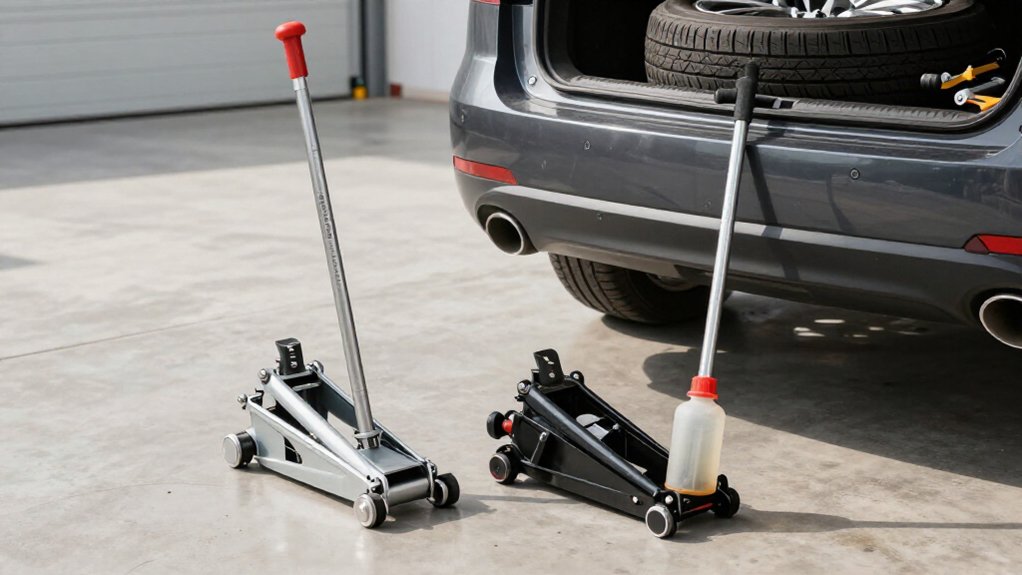
For most passenger cars, keep a compact scissor jack in your trunk: it stores easily and reaches approved lift points for a tire change.
Choose a bottle jack only if its fully lowered height clears your vehicle and its capacity and lift range meet the job; some models start around 7.5 inches.
Park on firm, level ground, chock a wheel, and use manufacturer-approved points.
Never work beneath a jack alone; jack stands provide support.
Check reach, effort, and fit before choosing.
Trunk-Ready Jack Snapshot
A scissor jack is usually the more convenient trunk-ready choice: it folds compactly and is designed for roadside tire changes. Before you pack a bottle jack, measure your vehicle’s lowest clearance and compare it with the jack’s collapsed height. Conventional 3-ton models often start near 7.5 inches, which can exceed a car’s 5–7-inch clearance.
Mini models may fit lower, but limited travel can constrain wheel lift. For roadside handling, secure the vehicle on level, firm ground and use the jack only at approved lift points.
| Option | Trunk check |
|---|---|
| Scissor jack | Compact; roadside-ready |
| Bottle jack | Check starting clearance and weight |
Choose the model you can store securely and position safely; never rely on a jack alone while working beneath your vehicle, and follow your owner’s manual.
Scissor Screw vs. Hydraulic Ram
How quickly you lift a wheel depends on the jack’s mechanism: a scissor jack uses a threaded screw you crank repeatedly, while a bottle jack’s hydraulic ram raises the vehicle with less effort per lift. With a scissor jack, each handle turn advances the screw and opens the linked arms, so you supply the work through repeated cranking.
A bottle jack uses hydraulic pressure: pumping its handle moves fluid into a cylinder, extending the ram with less physical effort for each increment. That advantage depends on correct setup; you must position the bottle jack upright on a firm, level surface, and its body must fit beneath the vehicle. Check your vehicle manual for approved lifting points and jack type before use.
Never rely on either jack to hold a vehicle while you work underneath. After lifting, support the vehicle with properly rated jack stands. Keep hands clear of moving parts, and stop if the jack shifts or feels unstable.
Lift Range and Reach
Beyond pumping effort, check both the jack’s starting height and its available travel.
Scissor jacks usually lift standard passenger cars, but may lack reach for taller trucks or SUVs. Bottle jacks may reach higher, but minimum height can prevent placement beneath low-clearance vehicles. Check measurements before positioning:
- Compare starting height with vehicle clearance; many conventional 3-ton bottle jacks start near 7.5 inches, too tall for some 5–7-inch clearances.
- Confirm travel: a 3-ton bottle jack reaches about 15.56 inches, versus roughly 19.75 inches for a floor jack.
- Match usable range to required wheel-off height; limited travel may require repositioning.
Choose by usable range, not capacity alone; confirm safe fit and enough travel for wheel-off height.
Check your vehicle’s specified lift points, and never work beneath a vehicle supported only by a jack.
Crank Effort and Grip
With a scissor jack, you turn a threaded screw by hand, so repeated cranking takes effort and your grip affects how smoothly the lift rises. You must maintain a firm, controlled hold on the handle and turn steadily; rushing or letting your grip slip can interrupt the lift.
Apply force through the intended handle, and stop if the screw binds or the jack shifts; don’t place any part of your body beneath a vehicle supported only by a jack.
A bottle jack uses hydraulic pressure to raise a load quickly with less effort, which can help when you’re changing a tire under time pressure. Pump deliberately and monitor the lift; pressure-based action offers less fine control than screw threading, so don’t assume speed means precision.
Jack-Point Compatibility
Before choosing a jack, check that its fully lowered height lets you place it under your vehicle’s factory jacking point. A rated bottle jack still won’t help if its starting height exceeds clearance: a common 3-ton model stands about 7.5 inches tall, too high for many sedans with 5–7 inches beneath the jacking point.
- A scissor jack suits compact, standardized passenger-car points, but may lack reach or clearance on a taller, heavier SUV.
- A bottle jack needs its base seated on a load-rated point; wrong placement can press unreinforced bodywork and destabilize the lift.
- Confirm you can align it precisely with the exact factory point and retain enough travel, especially if the point is narrow or offset.
Don’t jack if placement feels forced or unstable.
Hydraulic Seal Replacement Intervals
Bottle jacks don’t have a universal seal-replacement interval; inspect them periodically and replace worn seals when performance or condition calls for it. Your maintenance plan should prioritize periodic inspection, not calendar-based seal changes.
Check hydraulic oil and top it up only when needed, using the fluid and procedure specified by the manufacturer. If lifting performance declines or you find signs of oil contamination, stop using the jack, lower the load, and inspect the seal surfaces; replace seals if inspection confirms deterioration. Don’t continue lifting with uncertain condition.
Dirt or water entering around the rod, overextension near maximum height, and uneven ground can shorten seal life, so keep the rod clean and protected, avoid maximum extension, and set the jack on firm, level ground. Store it collapsed. These steps help you reduce damage and replacement frequency.
Scissor jacks use screws, not hydraulic seals, so this interval applies only to bottle jacks.
Seal Wear and Leakage
Inspection, not a fixed replacement schedule, helps you catch seal wear before it compromises a bottle jack. Check the ram and hydraulic cylinder for oil wetness; leakage can slow lifting or prevent the jack from reaching its height. If you need pumping for the lift, treat that performance drop as a warning, not a reason to keep operating.
- Bottle-jack seals wear faster when you cycle loads or extend the jack to greater heights.
- A scissor jack uses a screw and gears, so hydraulic seal leakage isn’t a concern; worn threads can still collect contamination and increase friction.
- If you see fluid leaking from a bottle jack, stop using it for lifting. Never trust it to support a vehicle; failed seals can’t safely hold loads.
Emergency Tire-Change Readiness
For trunk-ready tire changes, you’ll trade a scissor jack’s compact, lightweight design and slower manual lift for a bottle jack’s faster hydraulic action and greater weight. Check that your jack clears your vehicle and provides enough lift travel, then use the manufacturer-recommended lift point.
Never work beneath a vehicle supported only by a jack; use jack stands.
Trunk-Ready Equipment
For roadside tire changes, a scissor jack is usually the more practical trunk choice: it’s compact, lightweight, and designed to lift most standard cars. Check your vehicle’s lift requirements before relying on it, especially if you drive an SUV or pickup.
- A scissor jack stows easily beside your spare, unlike many heavier hydraulic bottle jacks.
- Confirm its rated capacity and lift height match your vehicle and wheel-swap needs.
- Choose a bottle jack for a tall, heavy vehicle only after checking its starting height and trunk clearance.
Capacity can increase minimum height: a 2-ton model starts around 7.125 inches, while 5-ton and 20-ton models start around 9.06 and 10.875 inches. That profile may prevent placement under a low-clearance car, even when its capacity is ample.
Emergency Tire-Change Safety
Before changing a tire, park on firm, level ground and place the jack base squarely at the vehicle’s designated lifting point; uneven surfaces can make either jack unstable.
For a roadside change, your compact scissor jack is the trunk choice, but you’ll turn its handle until the wheel clears the ground, which takes effort and time. A bottle jack may lift a taller vehicle higher; however, its tall body may not fit beneath a low-clearance car. Check its fully lowered height against your vehicle’s minimum ground clearance before packing it.
Some 3-ton models start around 7.5 inches, while one can reach 15.56 inches. Once raised, never work beneath the vehicle supported by either jack. Set jack stands before underbody work, and keep the jack seated.
Roadside Spare-Tire Swaps
For roadside readiness, you’ll usually find a compact scissor jack suited to passenger-car spare-tire swaps, while a bottle jack may better match a heavier vehicle’s weight and clearance. Before lifting, use only the manufacturer’s designated jack points, and never rely on either jack to support a vehicle while you work underneath.
Check that your jack’s capacity and lift range suit your vehicle and spare-tire change.
Emergency Readiness
A scissor jack is usually the better trunk choice for a roadside spare-tire change because it’s compact, lightweight, and provides enough lift for most passenger cars; a bottle jack can offer greater capacity and may suit higher vehicles, but its size can make emergency storage less practical.
Before you leave, check that your jack works, fits your vehicle, and reaches the required lift height. Keep it accessible.
- Confirm your jack’s capacity and lift range match your vehicle.
- Choose compact storage for rapid access.
- Carry jack stands for any work beneath the vehicle.
At the roadside, use firm, level ground and the manufacturer-recommended jack points. Never work beneath a vehicle supported only by a jack; use jack stands or a proper substitute.
Safe Lifting Points
At the roadside, place the jack only at the vehicle manufacturer’s designated lifting point, such as an approved pinch weld, frame section, or pad, so it supports a part designed to bear the load. Before you lift, park on firm, level ground, switch off the engine, apply the parking brake, and chock a wheel opposite the corner.
Uneven surfaces can let either jack’s small base rock. Seat the included saddle or pad squarely against the approved point; don’t improvise on thin body panels. Check clearance before positioning a bottle jack: its taller minimum height may not fit beneath a low vehicle.
Use a jack rated for your vehicle and the intended load; a compact scissor jack suits emergency lifts, while a bottle jack can handle heavier vehicles when properly rated. Raise the vehicle under control. Never work beneath a jack-supported vehicle; use correctly placed jack stands first. Watch the base and contact point; lower immediately if either shifts during lifting.
Spare-Tire Compatibility
A scissor jack is usually the more compatible trunk choice for roadside spare-tire swaps: it’s compact and designed for quick lifts of lighter passenger cars. Before carrying a bottle jack, check its closed height against your car’s clearance; a conventional three-ton model may start around 7.5 inches, exceeding a sedan’s 5–7-inch clearance.
- A mini bottle jack can fit lower: models start near 2.36 or 5.12 inches, but offer only about 0.78–1.18 inches of lift travel.
- Confirm either jack reaches the manufacturer’s lift point and provides enough height to remove and install your spare.
- After wheel removal, don’t rely on the jack alone for anything beyond the quick swap; support the vehicle with jack stands.
Check your owner’s manual before each roadside lift. Practice beforehand.
Compact Cars: Scissor Jack
For compact cars, a scissor jack is often the practical trunk choice because it folds into a small, lightweight package for roadside tire changes. It suits passenger cars and lighter vehicles because its lift range usually covers the height needed for a tire change. It also fits beneath cars with limited ground clearance.
Unlike a hydraulic bottle jack, it relies on a screw thread: you turn the handle repeatedly, so raising the car takes more effort. Position it only at your vehicle manufacturer’s recommended lifting point, on firm, level ground, and follow the owner’s manual. Once raised, support the vehicle with jack stands before doing any work underneath; don’t rely on the scissor jack alone. It’s intended for roadside lifting, not routine shop work.
Conclusion
Choose the jack that fits your vehicle’s approved lift points, ground clearance, and spare-tire plan—not simply the one that lifts faster. A scissor jack usually packs neatly and suits the roadside kit; a bottle jack can offer greater capacity, but often needs more clearance and a separate handle.
Before you travel, verify rated capacity and lift range, practice on level ground, and carry wheel chocks. Never work beneath a vehicle supported only by a jack.