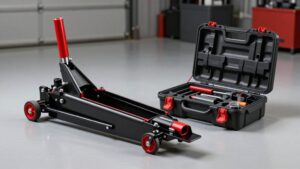
Bottle Jack vs Floor Jack: Which One for Trucks, SUVs and Cars?
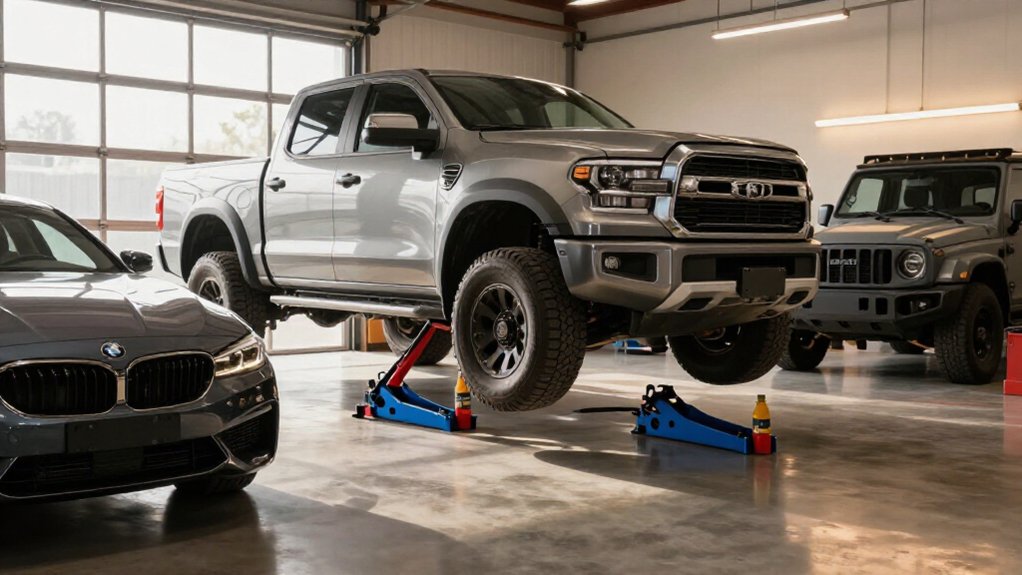
For trucks and heavy SUVs, choose a bottle jack only if its rated capacity, lift range, and fit match your vehicle’s lift point.
For low-clearance cars and routine garage work, a floor jack’s low profile, rolling base, and adjustment range usually make positioning easier.
Check handle clearance before pumping, and place either jack on firm, level ground.
Chock the wheels, lift only as needed, and support the vehicle with stands; never work beneath a jack alone.
Compare their limits next.
Jack Capacity by Vehicle Type
Choosing between a bottle jack and a floor jack depends on your vehicle’s weight and lifting needs. Match the jack’s rated capacity comfortably above your vehicle’s weight; never rely on a close margin.
| Vehicle | Bottle jack | Floor jack |
|---|---|---|
| Truck | Often up to ~20 tons | Often up to ~50 tons for frequent shop use |
| SUV | Usually sufficient for moderate-weight home maintenance | Preferable when you need more lift height and broader adjustment |
| Car | Capacity may suit home lifting; check rating | Generally offers more capacity; scissor jacks suit roadside changes |
For higher-clearance trucks or SUVs with larger tires, confirm the jack reaches your lifting points. Check the rating against vehicle weight, and support every raised vehicle with properly rated stands before you work beneath or beside it.
Pump-and-Arm Mechanics
Capacity tells you how much a jack can lift; its pump-and-arm mechanics determine how it raises and lowers the load.
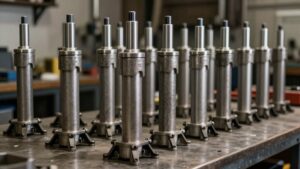
- With a bottle jack, you stroke the handle to pump fluid, building pressure that drives a piston upward through a vertical cylinder.
- To lower it, you open the quick-release valve; pressurized fluid returns smoothly to the reservoir.
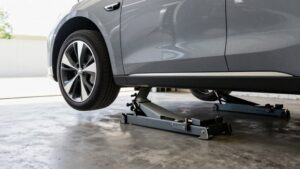
- A floor jack uses hydraulic pressure too, but its pump drives a horizontal cylinder that moves the lifting arm and platform over a low, wide base.
- Handle strokes affect how far the piston extends, so pump deliberately and maintain pressure. Different cylinder layouts create lift paths and control feel. Set each jack on stable, rated support, and never work beneath a load held only by a jack.
Vehicle-Specific Lift Heights
Vehicle height, tire size, and access space determine which jack will reach the lift point safely. On a low-clearance truck or SUV, a bottle jack may fit beneath the frame or pinch weld, but check that its tall body has room for insertion and removal. A floor jack’s lower profile may suit tighter access.
For many SUVs and lifted trucks, a floor jack’s broad height range can reach higher lift points without staging.
Larger tires may also require more suspension lift to clear the wheel; confirm the jack can provide enough travel. A scissor jack may handle a typical passenger car, but often can’t meet truck or SUV lift heights.
Whichever jack you choose, use the manufacturer-approved frame or pinch-weld point. Check minimum clearance and maximum lift before raising the vehicle, and support it with rated stands.
Pump Handle Clearance
When working in a tight garage, check pump-handle clearance before lifting. A bottle jack’s handle pivots through an arc, so it can strike the frame, floor, bumper, or nearby bodywork before you complete a stroke.
A floor jack usually gives you easier handle positioning and may reduce contact risk, but you still need full, unobstructed travel.
Before you lift:
- Set the jack squarely, then test the handle’s full arc without loading the vehicle.
- Point the handle toward open space; check for contact at every stroke.
- If blocked, reposition the jack or use a longer-reach handle before lifting.
- Don’t pump partially: incomplete strokes can leave the vehicle under-supported.
Confirm the setup again before raising the vehicle, and stop if anything interferes at any point.
Frame and Ground Clearance
After confirming the handle has room to move, check that the jack fits beneath the lift point.
A bottle jack suits a truck or SUV with enough clearance beneath its frame. Its upright body needs room as it extends, so don’t force it under a low crossmember or frame rail. A floor jack starts lower and rolls horizontally, making it more practical for low-slung cars and trucks.
For higher vehicles, a floor jack’s broader height range can provide lift without awkward positioning. Bottle jacks may need careful placement on uneven ground.
Before lifting, inspect the lift point’s geometry, including frame notches, pinch welds, or crossmembers. Confirm the jack clears tires, skid plates, and body panels and reaches the required height before you apply any load.
Storage Space and Setup
A bottle jack’s compact, upright shape usually fits more easily in a trunk or toolbox, while a floor jack takes more garage space.
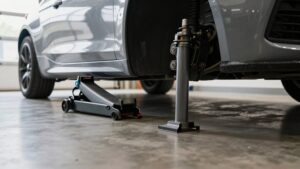
For a bottle jack, check the clearance beneath your truck or SUV before setup; its piston must reach the lift point. If there isn’t enough gap, drive onto suitable blocks, then position the jack. A floor jack’s low, wide rolling base slides under many vehicles more readily, and its broader height range can simplify setup on higher SUVs.
- Match storage to your transport needs and garage space.
- Place either jack on level, firm ground before lifting.
- Check access and keep the jack stable and centered during setup.
- After lifting, support the vehicle with jack stands; never work beneath a jack alone.
Overload and Seal Failure
Although bottle jacks and floor jacks use different designs, both can fail if you exceed their rated capacity: excess load stresses the seals and piston, increasing the risk of hydraulic leaks.
Choose a jack rated for the vehicle and load; a small bottle jack supporting a heavy truck or SUV corner can experience pressure spikes that speed seal wear. A floor jack may have a hydraulic assembly, but overload or off-center loading can still blow its seals. Watch for fluid seepage around the piston or base.
If the jack won’t hold pressure or slowly sinks, lower the vehicle and stop using it. Keep the jack level, follow the manufacturer’s instructions, and place a jack stand before you work; don’t rely on the jack alone.
Jack Pad Compatibility
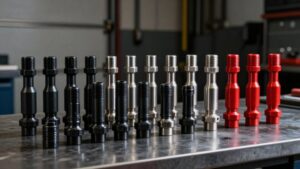
Choose a pad that fits your jack’s saddle and maintains full contact: bottle jacks usually need narrow, purpose-made pads, while floor jacks often use wider ones.
Verify that the pad aligns with your vehicle’s approved lift point and supports the pinch weld or contact surface without slipping. If the pad blocks full contact, don’t lift; use the correct pad and place jack stands after raising the vehicle.
Pad Fit and Contact
Before lifting, make sure the jack’s pad sits fully and squarely on a firm, approved frame or pinch-weld point, not a curved body panel. Match the top pad’s size and shape: flat or saddle to the contact area; a small pad can focus force, slip, or bend metal.
- For a truck or SUV, confirm the pad sits squarely before loading it.
- Choose enough lifting height and pad width for the vehicle’s clearance and load.
- Use a compatible adapter or cross-bar for recessed or irregular contact surfaces.
- Set the jack on a stable base; add a suitable pad or block on uneven ground.
Pause if contact shifts as you raise; lower the jack, realign the pad, and restart only when it remains centered, secure, and stable throughout.
Vehicle Lift Point Compatibility
Use only the vehicle manufacturer’s specified lifting points—such as approved frame rails, pinch-weld areas, or frame pads—and match the jack pad to the contact shape. A wrong fit can bend body components or let the jack shift under load.
For trucks and SUVs, position the pad on an approved frame rail or pinch weld; many cars use frame jacking pads. Bottle jacks stand tall and often have small tops, so their pads may slip on curved pinch welds. Choose an adaptor sized to the point.
Floor jacks usually offer broader, grooved saddles that seat common lift points more securely.
Check lifted-vehicle clearance: bottle jacks need vertical room; floor jacks roll under for precise placement. Center the pad, then use jack stands at rated points.
Emergency Roadside Tire Changes
For a quick roadside setup, you’ll usually find a compact scissor jack stored in your car, while a bottle jack needs enough clearance beneath the vehicle. Set either jack on firm, level ground, using a wood block or jack pad on soft surfaces, and lift only as high as needed.
Don’t rely on the jack alone—secure the vehicle with wheel chocks or a spare, and check that the jack’s rated capacity suits your vehicle.
Quick Setup
On a roadside tire change, a trunk-mounted scissor jack is usually quicker to access and position than a bulkier bottle or floor jack. Its compact shape and simple deployment suit typical cars on a flat shoulder, while a tall bottle jack may be difficult to fit beneath a low vehicle.
Before leaving home, check the jack’s rated capacity against your vehicle’s requirements; heavy-duty trucks and SUVs may need more than a compact emergency jack provides.
- Check your vehicle manual for lift-point locations and specified jack capacity carefully.
- Keep the jack, handle, and lug wrench together for fast access.
- On uneven ground, a hydraulic jack may not provide a workable setup.
- Choose the compact scissor jack when shoulder space and vehicle clearance limit positioning.
Safe Lifting
Although a bottle jack can lift a truck or SUV, use it roadside only if it fits beneath the vehicle and aligns securely with the manufacturer-approved lift point.
For emergencies, check clearance; its tall body may not fit. Confirm the approved lift point and center the saddle. Set the jack on firm, level ground; on gravel or soft soil, use a board to prevent sinking or tilting.
Match capacity to vehicle load. Many bottle jacks lift up to 20 tons; scissor jacks generally suit lighter cars. A scissor jack may be more practical roadside, while a floor jack is too bulky to bring. Afterward, support the vehicle with a jack stand or wheel chocks. Don’t rely on the jack alone while changing the tire.
Roadside Portability
A scissor jack is usually easier to carry for roadside tire changes because it folds compactly into a trunk or spare-tire well. A bottle jack can handle an emergency, but its greater height and weight for its rated lifting power make it less convenient beside traffic. It also needs more clearance beneath your truck or SUV to position the saddle, a challenge on uneven ground or low vehicles.
- Park on firm, level ground and keep clear of traffic before you begin.
- Follow your vehicle’s recommended lifting point; incorrect placement can cause jack failure every time.
- If you carry a bottle jack, pack a flat base or wood block and wheel chocks.
- Set the base securely, chock wheels, and confirm stable contact before lifting slowly.
Truck, SUV, and Car Picks
For trucks and heavy-duty SUVs or vans, choose a bottle jack when its capacity and lift point suit the vehicle; its compact design works well for roadside use and can handle heavy loads. Check the rating against your vehicle’s weight and use only approved lifting points.
For an SUV with moderate or higher ground clearance, consider a floor jack. Its wide base and greater height range can improve stability when you position it correctly.
For routine car maintenance in your garage, a floor jack rolls under the vehicle and lifts smoothly. Always support a raised vehicle with properly placed jack stands; never work beneath a jack alone.
Choose a bottle jack for compact trunk storage and emergency lifting. Floor jacks may offer higher capacity, but select either type for the load and lift point.
Conclusion
Choose a jack by matching its rated capacity, lift range, and clearance to your vehicle—not by jack type alone. A bottle jack suits many trucks and SUVs, while a floor jack often offers easier positioning for cars and low-clearance vehicles.
Check the manufacturer’s lift points, use a compatible pad, and work on firm, level ground. Never rely on a jack alone: support your vehicle with correctly rated jack stands before working underneath.
Bottle Jack Reach & Capacity Selector
Checks a bottle jack's ton rating, closed height and reach (stroke + extension screw) against your vehicle's lift-point load and height.
Engine Hoist Boom Capacity Checker
Compare engine weight with your hoist's data-plate rating at each boom position: utilization, margin and the longest position within rating.
Home Garage Lift Clearance Checker
Check if a car lift, ramp or jack fits under your garage ceiling: usable rise, headroom and pass/fail from your own measurements.
Truck & Farm Jack Reach Checker
Enter lift-point, target and jack heights to see if a jack fits under your truck and reaches the height needed to lift the tire.
Low Profile Floor Jack Fit Checker
Enter your jacking-point clearance and target lift height to see which of 17 spec-verified low profile floor jacks fit under your car and reach.
Transmission Jack Height and Capacity Planner
Enter transmission weight, your margin and mount height to see which listed transmission jacks reach your lift or floor job and carry the load.
Flat Tire Scissor Jack Height Checker
Enter your flat-tire clearance, lift and vehicle weight to see if a scissor jack fits under, reaches high enough and is rated for the load.
Jack Point Pad and Adapter Picker with Height Stack
Check jack pad adapter fit: pick a pad type for your jacking point and see if the jack + pad height stack still fits under the car.