Are Aluminum Floor Jacks Safe? Strength, Ratings and Weak Spots
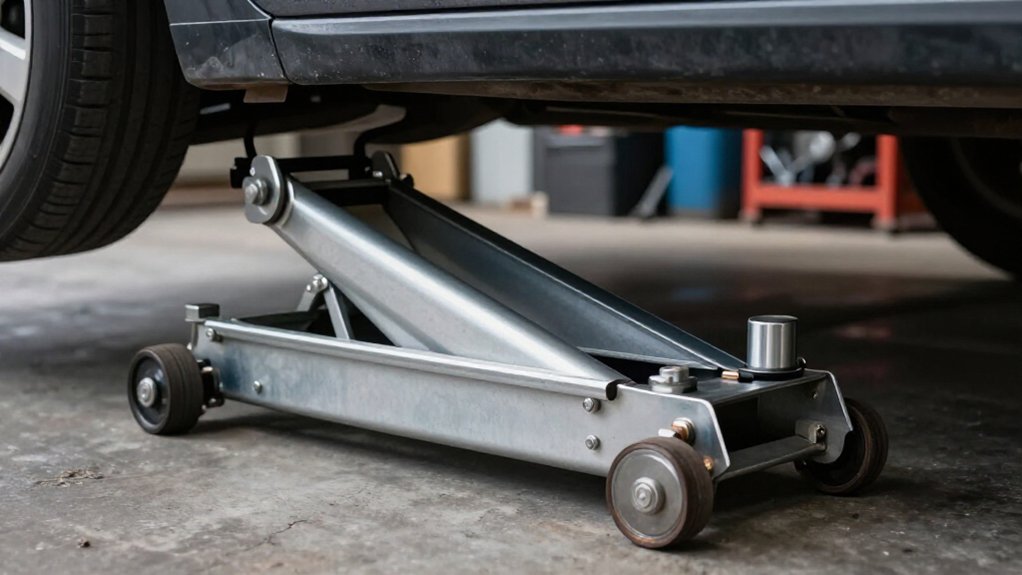
Aluminum floor jacks can be safe when you match rated capacity to the load, use approved lift points, and support the vehicle with rated jack stands. Their material alone doesn’t establish strength; design testing, condition, and correct use matter.
Repeated loading can fatigue arms, while leaks, damaged joints, or off-center placement can cause sudden failure or instability.
Keep the setup level and inspect it before lifting.
The sections ahead explain key limits and practical checks.
Rated Capacity, Frame Fatigue
A floor jack’s rated capacity is meaningful only if testing supports it and the frame has an appropriate safety factor; the aluminum itself doesn’t determine whether the jack is safe. Check whether the manufacturer publishes test methods and load limits; ratings in the two- to three-ton class don’t prove performance.
Repeated lifting can reduce frame stiffness or alter geometry without an obvious break, so consider duty assumptions and how often you lift near capacity. Loads may rise on critical frame sections near maximum lift height as leverage changes and stiffness falls.
Inspect joints and contact points for cracks or corrosion; fillets, holes, and transitions can concentrate stress. If motion becomes uneven or lifting feels less smooth under load, stop the jack and have it assessed.
Aluminum’s Heat-Treated Lift Arms
Although a jack’s published 3-ton or 7,000-pound rating may cover a static load, its heat-treated aluminum lift arm can still be the weak point under repeated bending. You can’t assume the rating guarantees fatigue life. Aluminum strength depends on alloy, heat-treatment quality, and manufacturing control. Correct heat treatment develops the microstructure, but casting porosity or variation can reduce stiffness and strength under repeated bending.
As you cycle the jack, flexing near stress limits can initiate cracks at pin bosses, bends, or weld/casting junctions, where bending stress concentrates. Inspect the arm for cracks, spreading deformation, or corrosion at joints before use. Don’t use an arm with suspected damage: a crack can propagate and cause failure. Have the jack assessed or replaced; its label can’t confirm condition.
Wheelbase and Tipping Stability
How stable a floor jack feels depends largely on its footprint and placement, not simply on whether it’s aluminum or steel. A wider, flatter stance and low center of gravity help resist tipping near axle. Aluminum and steel differ in stiffness and fatigue margin, but poor geometry often creates the greater practical risk.
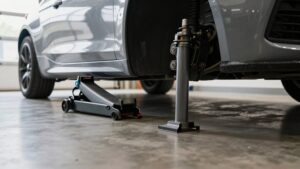
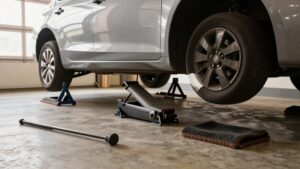
Center the saddle under the lift point on firm, level ground; off-center contact can side-load the jack and promote rotation or slip. When lifting at an end, check that the starting height and lift range let you raise only as much as needed, since greater extension raises the center of gravity. Afterward, support the vehicle with rated steel jack stands; don’t work beneath a jack alone.
Single- and Dual-Pump Designs
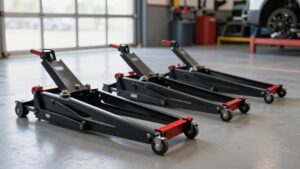
A single-pump jack uses one hydraulic piston, while a dual-pump design uses two to raise the load.
You may reach lifting height with fewer strokes on a dual-pump model, though actual speed depends on the jack’s design and load.
Check that its rated capacity and lift range suit your vehicle; pump type won’t compensate for overload or insufficient clearance.
Single-Pump Design
Single-pump aluminum floor jacks use one hydraulic cylinder to raise the load, so they may lift more slowly and require more strokes than dual-pump designs. Depending on the jack’s tested range and setup, you might need dozens of pumps to reach maximum extension. Check the manufacturer’s rated capacity and tested lift height in inches; a stated maximum alone may not show the usable range under load.
The single-pump layout can feel less consistent when hydraulic fluid quality or seal condition is marginal, so inspect for slow lifting, seepage, or loss of performance. Pay particular attention to the lifting piston and seals, force-transmitting pivot and arms, and structural connections near the base. Wear in these areas can reduce jack performance before a complete failure occurs.
Dual-Pump Design
Unlike a single-pump jack, a dual-pump design uses a faster low-pressure stage to raise the saddle quickly, then shifts to higher-pressure lifting as the load increases. That sequence lets you raise an unloaded saddle before the high-pressure stage takes over under load.
Dual-piston terminology doesn’t establish safe capacity: match the jack’s rated tonnage to your vehicle and use approved lift points. Because aluminum construction doesn’t determine capacity on its own, assess the complete hydraulic and structural rating, and don’t infer strength from pump configuration alone. One Blackhawk dual-piston model reached 21.5 inches after 1.5 pumps without a load; that’s a product-specific result, not a guarantee.
Keep the jack within its specified starting and maximum heights. Near maximum extension, monitor pressure stability and support the vehicle with rated stands before working beneath it. Greater extension can increase leverage and stress the frame and saddle, so pump count alone doesn’t establish safety.
Lift Speed Differences
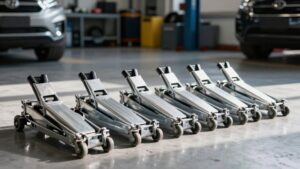
How quickly a floor jack lifts depends largely on how much fluid its pump moves per cycle: dual-piston designs can raise an unloaded saddle in fewer strokes than single-pump models. Tests illustrate the difference: a Blackhawk B6350 dual-piston jack reached maximum height in 1.5 pumps with no load, while the Big Red heavy-duty jack required 11.
That result supports a faster cycle advantage, but it doesn’t predict an exact lift time under a vehicle. Added load can increase pumping effort and cycle count, even when the relative advantage remains. Design also matters: the Powerbuilt Unijack, a bottle-jack/stand hybrid, needed 46 pumps to reach its maximum lock height unloaded. A pneumatic Vevor reached its measured maximum in about 1.9 seconds, but that timing depends on compressor output and valve control, not hand-pump strokes.
Compare speed figures only under similar conditions; use the jack’s rated capacity and stable supports, not speed, to guide your choice of jack.
Vehicle Weight Distribution
Your jack bears a corner share, not the vehicle’s full weight; front-to-rear balance determines how much load reaches the axle you lift. Fuel, passengers, and cargo can shift side-to-side balance, so estimate the heaviest plausible corner rather than relying on curb-weight averages.
As you lift, load can redistribute, concentrating force at the jack pad or stand saddle if contact isn’t even.
Front-to-Rear Balance
Front-to-rear weight distribution determines how much load the jack stands support. Use GVWR from your manual or door sticker to estimate axle loads, but don’t assume half the rating equals either axle’s load. When you lift the front, the rear axle remains grounded; the stands support the front axle’s share, not total GVWR.
Many cars approach 50/50, while a front-heavy sedan shifts more weight forward. Choose a stand rating that leaves the axle load comfortably below its intended capacity; a “3-ton” label alone doesn’t establish adequate margin. Confirm lifting-point geometry and stand placement, since poor contact can concentrate force and reduce capacity. Keep the vehicle centered and stable during lifting; front-to-rear imbalance can create tipping forces beyond what static ratings imply, even within rated weight.
Side-to-Side Differences
Side-to-side weight distribution can shift load away from the jack saddle’s center, creating lateral forces that threaten stability even when the vehicle stays within the jack’s rated capacity. That rating addresses vertical capacity; it doesn’t guarantee resistance to off-center shear.
Use the specified factory pinch weld or subframe point, and center the saddle beneath it; poor placement can narrow the stable support margin on one side. Although many aluminum jacks carry ratings around 6,000–7,000 pounds, check your model’s label and don’t treat total vehicle weight as proof of balanced loading.
Account for asymmetric components, such as a heavier engine side, by confirming both lifting points and stands bear comparable loads. Keep support at low-to-mid height; near maximum extension, greater deflection can reduce stability margins.
Load Shifts During Lifting
As you lift a vehicle, suspension compression or a rolling wheel can change the geometry and concentrate more load at a jack point than the vehicle’s weight distribution suggests.
Vehicle weight rarely reaches each lifting point evenly. When you raise one axle point, load can shift toward another support or a jack-stand leg, increasing local stress. A 6,000- or 7,000-pound jack rating doesn’t guarantee contact load stays below capacity if suspension compresses or a wheel rolls.
Keep the jack centered as you raise; a moving contact patch can shift weight off-center. Use the jack only to lift and reposition, then support the vehicle on stands under correct frame or suspension points, on solid, level ground. When the vehicle settles, stand loads can change suddenly and exceed intended distributed loading.
Aluminum Jack Storage Tips
Store your aluminum floor jack in a dry place away from road salt, which can corrode load-bearing lift points and increase the risk of deformation or failure.
After use, wipe away grime and moisture. Apply a corrosion-inhibiting film to exposed aluminum so salt and water don’t reach moving parts or scuffs. Keep sand and grit off the saddle underside and contact pads; abrasives can create stress risers that weaken the structure over time.
Retract the jack before storage rather than leaving it fully extended when unloaded, to limit seal wear and sticking that could cause uneven lifting. Support it upright or flat, not at an angle that could bend its frame or arms. Prevent impacts and twisting forces, which may leave misalignment.
Hydraulic Pressure Can Fail
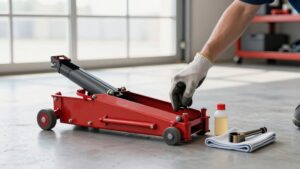
Even when an aluminum floor jack’s body looks intact, damaged seals or a leaking bypass valve can let hydraulic pressure fall and cause the load to drop suddenly. Your jack supports weight through pressurized fluid, so a cracked line, worn seal, or stuck release valve may cause abrupt lift loss without warning. Rated capacity assumes intact seals and specified operating conditions.
Exceeding it or using the jack under side-loading increases pressure-related failure risk. A bypass valve should limit overload, but leaks or sticking can prevent pressure from stabilizing safely. You can’t see internal seal wear, so inspect for leaks and test lift stability before use. Never rely on the jack alone; use rated support stands in place to hold the load while you work.
Wrong Lift-Point Placement
Where you place the saddle can matter more than the jack’s rated capacity.
A 6,000, 7,000-pound rating assumes correct loading; it can’t compensate for poor contact. If you miss the vehicle maker’s specified pinch-weld or frame point, the saddle may concentrate force, bend the structure, or slip, even below the jack’s limit. Risk increases as you raise the vehicle: changing geometry can reduce stable contact and contribute to a sudden drop or tip.
- Confirm the exact lift point in your vehicle’s manual.
- Keep the jack vertical and center its saddle under that point.
- Don’t lift against rust, damage, or an uneven surface.
Inspect contact as the jack rises, and stop if the saddle shifts or the vehicle moves unexpectedly.
Correct placement matters because misloading can defeat a jack designed for its stated capacity. Your jack’s aluminum construction isn’t the only factor: off-center loading can impose localized stresses the design doesn’t assume. Never rely on capacity figures alone to judge a setup.
Use the specified contact area and follow vehicle and jack instructions; if you can’t verify firm, centered engagement, lower and reposition.
Check Jack Recall Status
Before using an aluminum floor jack, check the manufacturer’s site and the U.S. CPSC recall database for your brand and model. Look for notices involving casting, overload, or pump/valve failures.
Match recall details against the jack’s label, including model number, serial number if present, and rated capacity; campaigns may cover batches or lots.
If your jack appears in a recall, stop using it immediately, even if it seems to work. Follow remedy instructions before lifting a vehicle. Don’t assume an old jack is safe; avoid new-old stock unless you can verify its non-recalled configuration.
If you can’t confirm recall status for your unit, treat it as unknown. Don’t rely on capacity alone. Use jack stands, and stay within the jack’s lifting range and starting-height limits.
Conclusion
Aluminum floor jacks can be safe when you match the rated capacity to your vehicle, use the correct lift points, and work on firm, level ground. Check the frame, wheels, and hydraulics for damage, and confirm the jack isn’t subject to a recall.
Never rely on a jack alone: support the vehicle with properly rated jack stands before working underneath. Follow the manufacturer’s instructions, store the jack as directed, and stop using it if its condition or stability raises concern.