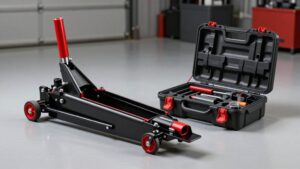
Low-Profile Jack vs Regular Floor Jack: Which Fits Under Your Car?
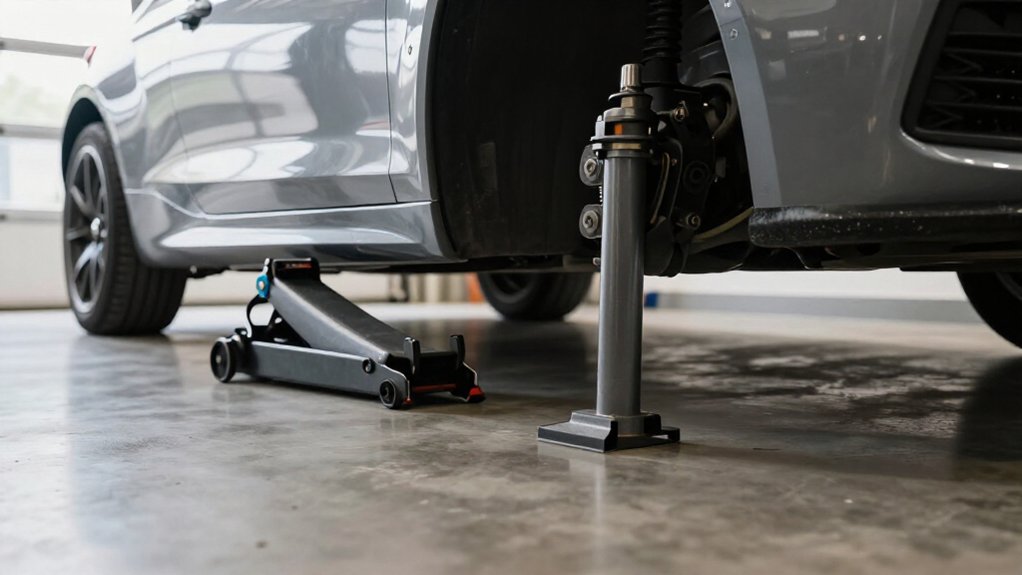
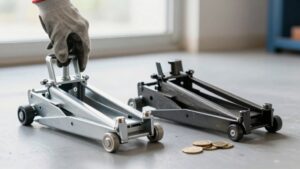
A low-profile floor jack fits if its minimum pad height clears your car’s designated lift point: the Pittsburgh starts at 3.8 inches, versus 5.3 inches for the Blackhawk B6350.
Check that its maximum lift also reaches the job; low-profile models may top out lower.
Match the saddle to the vehicle-approved point, not an unreinforced rocker panel.
Once raised, support the car with rated jack stands—never work under a jack alone.
Next, check the details.
Minimum Height and Clearance
Before buying or lifting, compare the jack’s minimum pad height with your car’s ground clearance. This measurement determines whether you can slide the jack beneath the rocker or cross-member and reach the first lifting point safely.
| Jack | Minimum height | Fit note |
|---|---|---|
| Pittsburgh 3-Ton Low-Pro | 3.8 in | Low profile |
| Blackhawk B6350 | 5.3 in | Traditional |
If your car sits low, a higher starting height may keep the jack from reaching the correct position. Don’t assume adequate maximum lift height solves this: verify insertion clearance using the stated minimum pad height, then confirm the lifting range suits the task.
Never force a jack under the car or begin lifting from an unstable, incorrect contact point. Check clearance along the exact entry path before you make your choice.
Arm, Saddle, and Pump
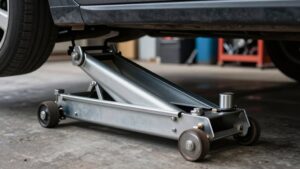
Check that the jack’s minimum saddle height clears the rocker or cross-member so its lift arm can reach the correct support point. A low-profile jack’s shorter lift arm path helps its saddle reach low vehicle structures that a regular floor jack may not clear. The saddle, or pad, must contact the vehicle’s specified lifting point; don’t position it against a rocker panel unless your vehicle’s manual identifies that location. Some low-profile models start at about 3.8 inches, so compare that figure with the available clearance before you roll the jack underneath.
The hydraulic pump moves incompressible fluid to raise the piston. Pump count varies with jack geometry: one low-profile model reaches full height in seven strokes, while a space-saving design takes 46 unloaded pumps. Check operating effort and follow the manual.
Lift Speed and Stability
A low-profile jack may reach the car sooner but offer less maximum lift: one tested model rose from a 3.8-inch minimum pad height to about 19.5 inches, compared with 21.5 inches for a traditional jack. That range can affect whether you finish the job without repositioning, which may compromise stability.
Lift speed depends on pump design, not profile alone; one dual-piston jack reached full height in 1.5 unloaded pumps, while a space-saving model required 46.
- Check the lowest lift point and stand height before buying.
- Choose a range that covers the task to avoid a mid-lift reset.
- A wide base and wheels improve balance and reduce tip/slip risk.
- Set the jack on firm, level ground and support the vehicle with rated stands securely.
Handle Reach and Maneuverability
Longer chassis and arm geometry can help a regular floor jack roll farther under a car and reach a cross-member; the Blackhawk B6350, the longest tested, was easier to position. That extra reach can let you steer the wheeled base toward the lift point and line it up with less repositioning.
By comparison, a low-profile jack’s shorter geometry may require more precise placement before you start pumping, even when its compact profile clears the car. Check both minimum pad height and lift reach against your vehicle’s lowest lift point; a jack that fits beneath the nose still needs to roll far enough to reach the intended point.
Keep the handle aligned so you can pump without forcing the jack at an awkward angle. Don’t push or pull a loaded jack to correct alignment. Set up on firm, level ground, follow the vehicle’s lift-point guidance, and use rated stands once raised before working beneath the vehicle.
Unibody vs. Body-on-Frame Fit
Your vehicle’s construction helps determine whether a low-profile or regular floor jack will fit its lift points. Unibody cars often place reinforced pinch welds or designated lift points close to the floor, where a low-profile jack’s 3.8-inch minimum pad height may reach without scraping. For trucks and SUVs, exposed frame points and cross-members sit higher, so a regular jack starting at 5.3 inches can offer a stable base.
- Check starting clearance and confirm the saddle reaches your intended lift point before lifting.
- Follow vehicle lift-point guidance; never support unibody panels outside reinforced areas.
- A low-profile jack may sacrifice reach and lift efficiency; one 3-ton model reached 19.5 inches in seven pumps.
- Choose a regular jack for higher frame points unless ground clearance limits access.
Hydraulic Seal Wear
Seal wear can weaken a floor jack’s ability to hold pressure as its piston cycles over time. Worn seals let small amounts of hydraulic fluid bypass the piston and travel through the hydraulic path. You may need more pump strokes, or the jack may creep down under load.
Either symptom can compromise a stable lift, so stop using the jack and lower the vehicle safely if you notice pressure loss.
Frequent garage use, contamination, and persistent moisture can accelerate seal degradation. Repeatedly exceeding the jack’s rated capacity adds stress and can hasten failure. Inspect around the pump and piston for oil seepage; leaks often appear before creep or reduced lift height. Don’t work beneath a vehicle supported only by a floor jack; use properly rated stands.
Frame Clearance at Full Lift
A jack that fits beneath your car at its minimum height may still bind before reaching the lift point you need. Check clearance at the frame or cross-member as the arm rises; initial fit doesn’t guarantee full travel. A Pittsburgh 3-Ton Aluminum Racing Jack pairs a 3.8-inch minimum pad with about 19.5 inches of lift, but your contact point must clear the underside throughout that range. A Blackhawk B6350 lifts about 21.5 inches from a 5.3-inch minimum pad; extra travel helps only if the frame stays clear.
- Check clearance at final height, not just initial contact.
- Confirm your planned jack-stand height also fits beneath the vehicle.
- Near maximum lift, watch for misalignment or incorrect frame contact.
- Stop if binding develops; reposition before final height adjustments.
Pros and Cons of Frame Length
A longer frame can help you reach the cross-member without awkward positioning, but you still need to confirm the pad aligns with an approved lift point. A compact frame may fit tighter clearances, yet it can limit reach and increase slip or tip risk if you can’t place the pad safely.
Check both the jack’s minimum pad height and reach before lifting.
Long-Reach Advantages
Long-reach floor jacks can make it easier to position the saddle beneath cross-member lift points, especially when those points sit far from the jack’s base; the Blackhawk B6350, for example, had the longest frame in one tested group.
- You can align the saddle with the specified cross-member point without reaching at an awkward angle.
- That reach helps when your car’s lift points sit well ahead of the jack’s base.
- Check the minimum pad height against your car’s clearance first; a 5.3-inch pad still must fit before lifting.
- Position the base squarely on firm, level flooring; longer leverage makes careful placement essential for stability as you pump.
Expect a longer frame to take more floor space and complicate storage in a tight garage or maneuvering near obstacles.
Before lifting, verify capacity and support the vehicle with jack stands; never work beneath a jack-supported car.
Compact Frame Trade-Offs
Although a compact frame can fit into tight spaces beneath a car, its shorter lift arm gives you fewer safe positioning options and may make it harder to center the saddle under the lift point. That reach limitation can force you to reposition the jack precisely before loading it, slowing setup and making stable placement less straightforward. A longer chassis generally rolls farther beneath the car and aligns more easily with common cross-member lift points, helping you center the saddle on the contact area.
But compact designs can access tighter points that a regular jack may not reach. Don’t assume compact means low enough: the Powerbuilt Unijack’s minimum pad height is 11.0 inches, too high for some low-clearance cars. Its shorter setup also reduced leverage; it took 46 pumps to reach 20.5 inches without a load. Check clearance and the lift point before choosing; never work beneath a car supported only by a jack. Use properly rated stands after lifting.
Seasonal Tire-Swap Scenarios
For winter tire swaps, a low-profile jack with a starting height near 3.8 inches may fit where a regular jack’s 5.3-inch-or-higher pad can’t. For summer changeovers in a garage, a regular floor jack may roll and pump more easily, but check that its pad clears your car’s lift point.
Match the jack’s capacity to your vehicle, use stands that reach the needed height, and inspect lift points for rust or damage before each seasonal swap.
Winter Tire Swaps
When winter roads or snowbanks limit your positioning, check the jack’s minimum pad height before starting a seasonal tire swap.
For a low-clearance car, a Pittsburgh 3-Ton Aluminum Racing Jack starts at 3.8 inches and reaches 19.5 inches. A traditional Blackhawk B6350 starts around 5.3 inches, though its lift height reaches 21.5 inches. Check starting clearance first; don’t assume greater lift means better fit.
For faster, smoother winter changes in a shop, use a hydraulic floor jack rather than a crank-style jack; it still needs clearance to roll underneath.
- Set jack stands after lifting; never work with the jack alone.
- Avoid compromised ground and severely rusted lift points; reduce slip risk.
- If the pad won’t fit, reposition safely; don’t force the jack underneath.
- Check clearance before pumping.
Summer Changeovers
For summer tire swaps, choose a jack that fits beneath your car before you start: a low-profile model may clear a tight gap with its 3.8-inch minimum pad height, while a regular-style jack listed at about 5.3 inches may not. If you drive a full-size sedan or SUV with normal clearance, a regular floor jack’s wide base and wheels can make repeat changes easier; it rolls into position and pumps smoothly.
A low-profile jack can handle tire work: one 6,000-pound model lifts to 19.5 inches and reached height in seven no-load pumps. Before lifting, verify starting clearance and match the pad height and lift range to your task. Set the jack at the vehicle’s lift point, then support the car with stands before removing a wheel.
Seasonal Clearance Needs
Seasonal tire swaps can expose a clearance issue: if your car sits low, the jack’s starting height may keep it from reaching the proper lift point.
Before each swap, measure clearance and compare it with minimum pad height. The Pittsburgh 3-Ton Low-Profile Aluminum Racing Jack starts at 3.8 inches and has a measured 19.5-inch lift, suiting low cars. A regular jack may fit a slightly low vehicle, but never force contact at an unintended point.
- Check the jack clears the underside before positioning it.
- Confirm the lift point aligns with your vehicle’s approved jacking location.
- Verify the lifting range lets you place jack stands securely.
- Ensure you can raise the car enough to clear the wheel.
Use jack stands; never depend on a jack alone.
Model-Specific Clearance Checks
Before choosing a jack, compare your car’s lowest clearance with the jack’s minimum pad height: the Pittsburgh 3-Ton Low-Pro starts at 3.8 inches, while the Blackhawk B6350 starts at 5.3 inches. Then confirm the jack’s maximum lift height covers the job: the Blackhawk B6350 reaches 21.5 inches, the Big Red AT84007R and Unijack reach about 20.5 inches, and the Vevor pneumatic reaches 15.8 inches.
Check that its starting height lets you place the pad squarely at the manufacturer’s lift point or cross-member; a jack that won’t fit there can’t be used safely, even if it later reaches the height you need. With ramps, match the range to your stands, raising only enough to set them at their lowest safe height before you get underneath.
Inspect rust.
Conclusion
Choose the jack that clears your car at its lowest point and reaches the lift point without awkward repositioning. Check the vehicle manual, measure clearance, and confirm saddle and frame compatibility before you buy.
A longer frame may improve reach, but it won’t suit every garage or chassis. Use the jack only on level, solid ground, then support the vehicle with correctly rated stands; never work beneath a car held up by a jack alone.