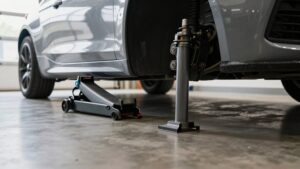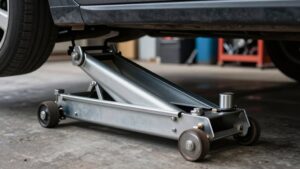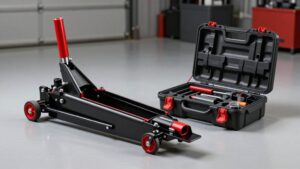
Electric Car Jack vs Floor Jack: Roadside Convenience or Garage Power?
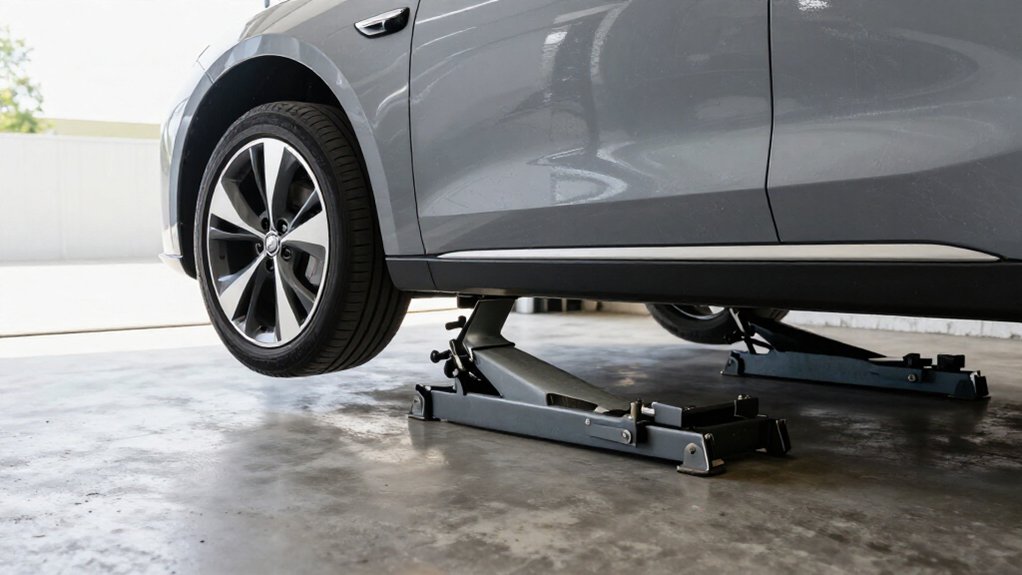
Choose an electric car jack for roadside convenience if your 12V outlet or battery connection works and its cord reaches the lift point. You’ll avoid pumping, but a weak battery or short cable can stop the lift.
Choose a floor jack for garage use when you need greater lift range and can manage its weight and handle space. Match capacity and clearance, park level, and use jack stands; details below can help you choose.
Power Cords and Crank Handles
With an electric jack, you trade a manual crank for a power cord: a model like the VEVOR has a 13-foot cord that can often reach the front or rear tire without placing you directly under the car.
A floor jack needs no cord access but requires room to position and pump its handle. Before lifting, check that the outlet or 12V source is close enough for safe, comfortable reach and can supply the load. If it can’t, your electric jack may not be usable roadside.
| Choice | Practical limit |
|---|---|
| Electric jack | Cord reach |
| Floor jack | Handle clearance |
Park on firm, level ground, secure the vehicle, and follow the jack maker’s lifting points; never rely on a jack alone beneath a vehicle. Always use approved supports before working underneath.
How Electric Jacks Connect
Most electric car jacks connect to a 12V cigarette-lighter outlet or directly to the vehicle battery, powering an electric hydraulic system instead of a manual pump. Before you connect the plug, park on firm, level ground, set the brake, and follow the vehicle’s jacking instructions. Connect the jack only as its manual directs: use the outlet plug or attach the supplied battery clamps to the correct terminals, observing polarity. Keep cables clear of hot parts, moving components, and pinch points.
A 13-foot cord, as on the VEVOR electric hydraulic floor jack, can help you position the unit near a front or rear tire without stretching the lead. Check that your outlet or battery circuit can supply enough current; an overloaded circuit can blow a fuse and stop the lift. Don’t substitute an extension or damaged cable unless the manufacturer approves it.
Some kits add a built-in tire inflator, but lifting still relies on an electrical connection. After connecting, operate the controls from a position where you can monitor the jack. If power falters, stop and resolve the connection issue before continuing.
Lift Height and Capacity
Electric jacks often provide less lift height than floor jacks: a VEVOR electric model, for example, has a measured maximum of 15.8 inches, though it’s advertised at 17.7 inches. That gap matters when you need enough height to position stands safely; advertised capacity doesn’t prove the jack can reach your target.
Floor jacks commonly lift higher: Blackhawk reaches 21.5 inches, Big Red 20.5, and a low-profile racing model 19.5. Use measured lift height and planned stand height to verify usable range. Capacity must match your load: a 6,000-pound electric jack may suit some cars, while floor models rated 7,000–8,000 pounds offer more margin.
- Compare measured lift range.
- Match rating to load.
- Check planned stand height.
- Use stands for support.
- Verify specs before buying.
Ground Clearance Requirements
Before comparing lift range, check whether the jack can fit under your car and reach the correct lifting point.
Ground clearance sets the jack’s minimum pad height limit; if that height exceeds the space beneath your car, the jack won’t fit. Check clearance where you’ll position it, with the flat tire and on your intended surface. Don’t judge an electric jack by maximum lift: verify its starting height.
VEVOR describes its electric floor jack as low-profile, but confirm its dimensions. For low cars, choose a low-minimum-pad design. The Pittsburgh 3-Ton Low-Pro starts at 3.8 inches; the Powerbuilt Unijack starts at 11.0 inches, while the Blackhawk B6350 starts at 5.3 inches. More lift travel can’t overcome inadequate entry clearance.
Factory Jacking-Point Compatibility
- Set the jack at its lowest setting; Big Red’s 3.8-inch height may suit low points better.
- Measure required rise: Vevor reaches 15.8 inches, Big Red 20.5, and Blackhawk 21.5.
- Position the pad squarely on the factory contact area; don’t lift from a panel.
- Inspect the metal for rust or deformation that could undermine contact.
- Confirm starting clearance and lift range before raising your vehicle; stop if alignment shifts.
Replacement Parts Availability
When a jack needs repair, an electric model can be harder to keep in service because key parts, the motor or gearbox, charging harness, and controller or valve pack, may be specific to the brand and difficult to source generically. By contrast, you can often find seal kits, pump cylinders, hoses, and wheels for hydraulic floor jacks through multiple vendors, provided you match the jack’s model design.
If your electric jack includes a tire inflator, you’ll also need to source its hose, nozzle, or pump head, adding another subsystem to inspect. Check whether the seller provides exploded diagrams and service-part SKUs for your exact model, including the charger or power cord; VEVOR, for example, specifies a 13-foot cord. Verify fit and follow the maker’s service instructions.
Motor and Battery Dependence
Because an electric car jack needs power to lift, a weak vehicle battery or an unavailable 12V outlet can limit its operation; the VEVOR model, for example, connects to a 12V cigarette lighter or directly to the car battery. Before lifting, confirm the source can deliver adequate current; a 13-foot cord offers flexibility, but it must reach without stressing the circuit or overloading a fuse.
- Check battery condition and outlet access before relying on lifting.
- If the vehicle can’t supply enough energy, the motor may not raise the load.
- Keep the cord clear of hazards and within reach of the flat tire.
- Don’t assume rated lifting capacity removes electrical limits during use.
- A manual floor jack avoids battery dependence, though you provide pumping force.
Setup Speed and Effort
You can position an electric jack and connect its power before lifting, while a floor jack needs repeated handle pumps. An electric model can raise a vehicle quickly, but you’ll need access to a 12V outlet or battery.
Whichever jack you use, place it securely at the vehicle’s lift point before raising the load.
Setup Time
An electric jack can lift faster with less pumping, but setup still takes care: position it under a suitable lift point, then connect it to a 12V outlet or the vehicle battery. Before lifting, confirm the pad reaches the approved point without forcing a poor angle.
- Check minimum clearance; the VEVOR needs 6.0 inches, while some low-profile jacks need 3.8.
- Place the jack on firm, level ground and keep the vehicle secured.
- Route its 12-foot cord clear of traffic, hot parts, and pinch points.
- Allow roughly two minutes for a VEVOR to reach 17.7 inches; access affects timing.
- If alignment or reach is wrong, stop and reposition before powering the jack.
Keep clear of the vehicle; never work beneath it without properly rated stands.
Manual Effort
Manual effort depends on both how the jack lifts and how much clearance you have to position it. An electric hydraulic floor jack, such as the VEVOR, can reach about 17.7 inches in two minutes; its 13-foot cord lets you place it near a front or rear tire without repositioning. You still need to align its saddle with the vehicle’s lift point.
A traditional floor jack requires you to roll it into place and pump the handle. The Blackhawk B6350 needs about 1.5 unloaded pumps to reach full height, while the Powerbuilt Unijack takes roughly 46. A low-profile Pittsburgh 3-ton jack needs seven strokes, but demands pumping.
Confirm clearance and lift-point access before raising the vehicle; power can’t compensate for unsafe placement.
Roadside Tire-Change Convenience
For roadside swaps, an electric jack’s compact storage and powered lift can make setup quicker than hauling a bulky floor jack. Check that its power cord reaches the tire and that its starting height clears your vehicle.
Lift only to change the tire; never work underneath a vehicle supported by a jack alone.
Compact Trunk Storage
Because roadside tire changes call for gear you can actually carry, a compact electric jack can keep the kit self-contained in your trunk, unlike a traditional floor jack that typically weighs 30–100 lb. When trunk space matters, you’ll pack a lighter unit more easily, especially if you change tires monthly.
A VEVOR-style jack’s 13-foot cord and roughly two-minute lift to 17.7 inches support a self-contained kit, but cord reach limits where you can store it relative to front or rear wheels. Check these storage requirements before choosing:
- Confirm starting clearance at the flat tire.
- Match lift height to wheel-off needs.
- Choose low-profile design for under-car access.
- Keep jack stands available for stabilization.
- Verify cord reaches intended wheel position.
Always store it securely, with its instructions.
Quick Roadside Setup
At the roadside, an electric jack can simplify setup: place it at the approved lift point, plug it into a reliable 12V outlet or car battery, then raise the vehicle. Some models, such as VEVOR’s, claim a 17.7-inch lift in about two minutes. Its 13-foot cord can reach the front or rear tire, easing placement.
Instead of rolling a floor jack under and pumping, you place, plug in, and lift. Setup time still depends on reliable power and a connection before lifting. A floor jack may move faster on level, firm ground, but its weight makes roadside storage and deployment less convenient. Check clearance around the flat and choose firm, level ground when possible. Raise only for the tire swap; use stands for other work.
Safe Tire Changes
Before a roadside tire change, check that the jack’s minimum pad height fits beneath the vehicle at the flat tire’s lift point and that its maximum lift height provides enough clearance to remove the wheel.
Then assess the setup:
- A 3.8-inch minimum suits low-clearance access better than the Unijack’s 11-inch minimum; confirm your actual lift point.
- Choose adequate travel: roughly 19.5 inches or 21.5 inches may provide useful wheel-removal clearance.
- With an electric jack, check power and reach; Vevor’s cord is about 13 feet.
- Park on firm, level ground; gravel and slopes raise tipping risk. A wider floor-jack base can improve stability.
- After lifting, place jack stands beneath the vehicle; never work with the jack alone.
Verify every contact point before you begin lifting.
Best for Emergency Trunk Kits
For an emergency trunk kit, an electric jack lets you lift on demand without pumping, and some models can raise a vehicle to about 17.7 inches in roughly two minutes using a 12V outlet or the car battery.
That convenience suits a compact kit. Choose a low-profile model that fits beneath your vehicle and provides useful lift height. Check cord reach: a roughly 13-foot cable can connect from the front or rear lifting point to the tire. Park on firm, level ground, secure the vehicle, and position the jack at the manufacturer-approved point.
After lifting, place rated jack stands before working; never rely on the jack to support the vehicle. A floor jack needs stable garage space for repositioning, while an electric model stores and deploys from your trunk.
Conclusion
Choose an electric jack when you need quick, low-effort roadside lifting and your vehicle, power source, and factory jacking points are compatible. Keep it level, respect its rated capacity and lift height, and never work beneath a vehicle supported only by a jack.
For frequent garage jobs, a floor jack offers dependable control and capacity, but you’ll need firm ground, clearance, and physical effort. Carry the tool that fits your real needs, use jack stands, and follow your vehicle manual before every lift without rushing.