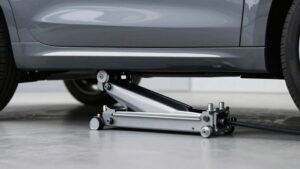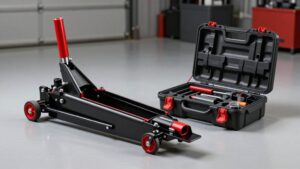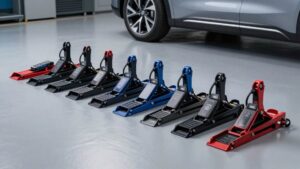
What Size Floor Jack Do You Need? Tonnage by Car, SUV and Truck
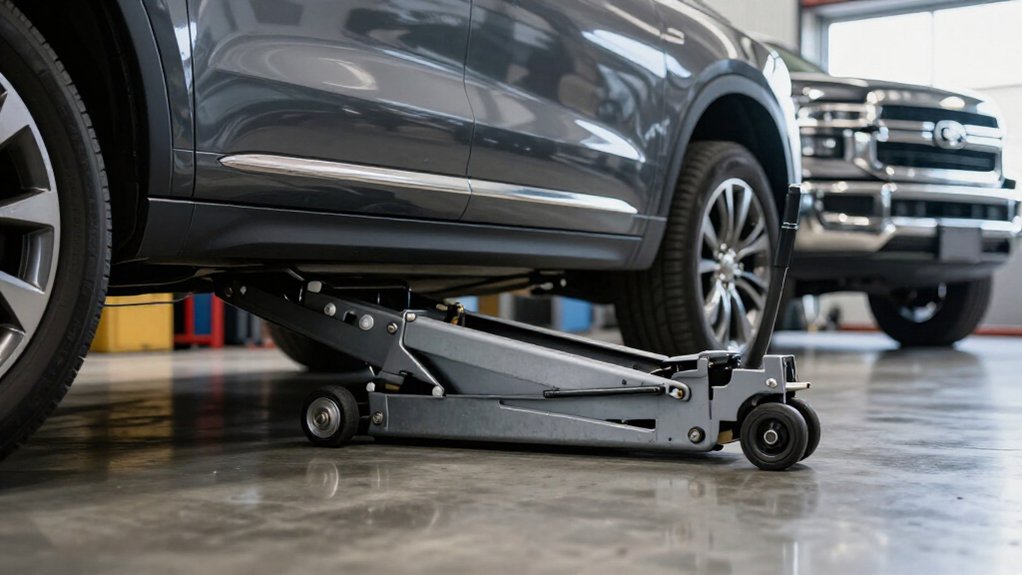
Choose a floor jack rated for at least 75% of your vehicle’s GVWR, using the door-jamb label or owner’s manual. A 2-ton jack suits many cars; SUVs and pickups typically need 3 tons, while heavy trucks may require 4 tons or more.
Check that the minimum saddle height fits beneath the approved lift point and maximum height lifts the tire clear. Park level, chock wheels, and use rated jack stands. Details can guide you.
Three-Quarter Capacity Rule
Use the three-quarter rule: choose a floor jack rated for at least 75% of your vehicle’s GVWR or GVW. Calculate required capacity by multiplying that rating by 0.75, then convert pounds to tons using 2,000 pounds per ton. This gives you a minimum capacity target, not a reason to operate the jack at its limit.
For example, an 8,000-pound GVWR requires at least 6,000 pounds (8,000 × 0.75), so choose a 3-ton jack or larger. You usually lift one corner or one end, but the jack still raises the applied load through its operating cycle. Capacity margin helps reduce strain and supports steadier performance. If your calculation falls between available ratings, size up rather than choosing the smaller jack throughout every lifting operation.
Vehicle-Class Jack Ratings
Match the jack to your vehicle’s weight class and the lift height you need. Compact cars and sedans typically pair with a 2-ton floor jack and 12–15 inches of lift. Mid-size SUVs and crossovers usually need 3 tons and 18–20 inches to clear their higher ride height.
| Vehicle type | Typical jack and lift |
|---|---|
| Cars and sedans | 2-ton; 12–15 in |
| Mid-size SUVs/crossovers | 3-ton; 18–20 in |
Most full-size SUVs and half-ton pickups suit 3 tons; choose 4 tons for heavy trims or towing. Heavier trucks and commercial-duty vehicles often need 4 tons or more and over 20 inches of lift. Check your vehicle’s weight guidance and confirm the jack reaches approved lift points. Use rated stands before working underneath.
Park level, chock wheels, and follow lifting instructions.
Tons, Pounds, and Capacity
After choosing a jack for your vehicle class, check its capacity against the vehicle’s gross vehicle weight rating (GVWR), listed on the driver-side door jamb or in the owner’s manual. One ton equals 2,000 pounds, so a 3-ton jack is rated for 6,000 pounds. As a practical safety margin, many recommend jack capacity equal to at least 75% of GVWR; for an 8,000-pound GVWR vehicle, that points to a 6,000-pound jack.
You usually lift one corner or one end at a time, so the jack handles only part of the vehicle’s weight. Still, don’t choose a rating that’s inadequate for the load or operation. Use 2 tons for compact cars, 3 tons for many SUVs and half-ton trucks, and 4 tons or more for heavy-duty work. Verify the jack’s capacity and lift range before use.
Minimum and Maximum Lift Height
Check the jack’s minimum clearance against your vehicle’s ground clearance to confirm the saddle fits under the lift point. Its maximum lifting height must raise the vehicle enough for a tire change and to position jack stands safely.
Measure the lift point or verify the manufacturer’s range, then match the jack height to your stands.
Minimum Clearance
Before choosing a floor jack, measure from the ground to your vehicle’s jacking point and compare that height with the jack’s lift range: its minimum must be low enough to fit under the car, while its maximum must reach your required working or jack-stand height. Check the jack’s minimum lift height against the lowest point beneath your frame or pinch weld; a low-profile sports car may need about 3–4 inches.
Don’t rely on catalog labels alone—measure your vehicle on level ground. Then confirm the jack can reach your planned work or stand-placement height within its rated travel. Compact cars and sedans commonly need 12–15 inches of lift, while SUVs, crossovers, and most pickups often need 18–20 inches. High-clearance or lifted vehicles may require extra reach, and cribbing may help with positioning. Use approved cribbing, never exceed the jack’s rating, and support the vehicle on jack stands before working underneath, before you commit to a model and begin lifting.
Maximum Lifting Height
Your jack’s lift range must both fit beneath the vehicle and reach the height your job requires. Check its minimum lift height before buying; low-profile cars may need a jack that clears just 3–4 inches. Then confirm maximum lift height reaches your lifting point without forcing the jack to bottom out.
Many compact cars and sedans need about 12–15 inches, while most SUVs, crossovers and many pickups call for 18–20 inches. For wheel work, allow enough rise to clear the tire and leave safe room to position jack stands. Measure from the ground to the intended jack point, then choose a jack whose full minimum-to-maximum range covers that measurement. Never extend beyond the rated range or rely on unstable positioning to gain extra height.
Vehicle Ground Clearance
Ground clearance determines whether a floor jack can slide beneath your vehicle: measure the clearance at the intended jack point and choose a jack with a minimum height below that measurement. Many low-profile jacks measure just 3–4 inches at their lowest point, but verify the specification and your actual clearance before buying.
Next, check maximum lift height against the work you’ll perform and the height of your jack stands. A tire change needs less travel than brake or suspension work, which may require a higher working position. SUVs, crossovers, and pickups commonly need about 18–20 inches of lift.
Your jack must reach the vehicle’s jack point, then raise it enough for safely positioned stands. If an aftermarket lift or high suspension prevents access, use properly placed cribbing or wood blocks; never force the jack beyond its rated range.
Tire Change Height
Check both lift limits when choosing a floor jack: its minimum height must clear the vehicle’s jack point, while its maximum height must raise the tire fully off the ground.
For a low-profile car, look for a 3-4-inch minimum so the saddle slides beneath the pinch weld or subframe. Confirm the ground-to-jack-point measurement or check your owner’s manual; leave a buffer rather than working at either end of the jack’s range.
For tire changes, compact cars and sedans often need 12-15 inches of maximum lift. SUVs, crossovers, and pickups may require 18-20 inches, especially when the jack point sits high. If maximum lift falls short, you won’t get the wheel clear; don’t improvise with stacked materials. Choose a jack that reaches the required height.
Match Jack Stands
Choose jack stands whose minimum height clears the gap to the lifting point and whose maximum height exceeds your working position. Most stands adjust within a fixed height range, so raise your vehicle only enough to position them correctly. For a typical half-ton truck, use stands rated for at least 6 tons; check that their maximum height exceeds your needed working height, often near the 18–20-inch range associated with mainstream pickup floor jacks.
For a 3/4- to 1-ton diesel, plan on 12-ton stands. Confirm their minimum height clears the ground-to-lifting-point gap, including any extra clearance needed to remove a wheel. Set stands on stable frame rails or suspension anchor points. Lower the jack onto them, then verify the vehicle rests securely before working underneath. Never exceed the stands’ rated height; use cribbing if needed.
Calculate Load Per Jack Point
To estimate the load at a jack point, start with your vehicle’s GVWR from the driver-side door-jamb sticker or owner’s manual, then divide by the number of points sharing the load—typically two when lifting one end or four for one corner—and round up.
This estimate is a planning figure, not the jack’s capacity target. Apply the three-quarter rule: choose a jack rated for at least 75% of the vehicle section you’re lifting. For an 8,000-pound GVWR truck, the minimum is 6,000 pounds, or three tons. Check that the jack’s minimum height fits beneath the selected point and its maximum lift raises that corner enough to remove the tire or access the work area. Size up; never rely on equipment close to its limit.
Low-Clearance Garage Floors
For a low-clearance garage, choose a low-profile floor jack with a minimum saddle height of about 3-4 inches so it fits under the vehicle’s jack point. Before you buy, measure ground-to-jack-point height and compare it with the jack’s minimum and maximum saddle heights before lifting.
Low-profile models often provide about 12-15 inches of lift; that can suit a sedan, but may not reach high enough for an SUV with greater suspension clearance. Choose tonnage for your vehicle and stable operation: 2 tons generally works for cars, while many SUVs and crossovers call for 3 tons.
On rough or slightly sloped concrete, place a jack base plate or suitable wood block beneath the jack. Low-profile jacks have little clearance to recover if they sit crooked.
Roadside Tire-Change Example
At a roadside pull-off, check your vehicle’s GVWR on the driver-side door-jamb label or in the owner’s manual, then size the floor jack to handle at least 75% of that rating: the “3/4 rule” provides capacity margin.
For example, choose a 2-ton jack for many compact cars and sedans, a 3-ton model for most SUVs, crossovers, and half-ton pickups, and 4 tons or more for heavy-duty or high-GVWR trucks. Check that its lift range reaches the approved lift point and raises the tire fully clear; trucks and SUVs often need more height than cars. Use firm, level ground when possible, and support the raised vehicle with rated jack stands; never use the jack to hold it. Follow the vehicle maker’s lift-point instructions throughout the change.
Unchocked Wheels Before Lifting
Once you’ve chosen a jack with the right capacity and reach, secure the vehicle before lifting: park on a level, hard surface, apply the parking brake, and chock both sides of the wheels that will stay on the ground. Don’t rely on the parking brake alone; a jack shift or slight slope can let an unblocked vehicle roll. Select firm, correctly sized chocks—or a solid wood block—and seat them fully against the tire tread. Set the transmission to Park for an automatic, or in gear for a manual, but still chock the wheels.
- Lifting the front? Chock both rear wheels.
- Lifting the rear? Chock both front wheels.
- Check each chock contacts the tread before raising.
Keep the blocking in place throughout the lift.
Confirm Factory Jacking Points
Before positioning the jack, check your owner’s manual or vehicle sticker for the exact factory jacking points; they vary by model, and the wrong spot can crush a pinch weld or damage the rocker panel.
Before lifting, locate the reinforced contact areas: often notched pinch welds behind the front wheels and ahead of the rear wheels, or frame rails beneath the rocker area.
Center the saddle on reinforcement; keep the jack vertical and don’t straddle thin sheet metal.
- On many cars, use marked corner points, identified by small notches or triangles.
- On trucks and most SUVs, use the labeled frame area; avoid the floor pan, exhaust, and suspension arms.
- After positioning the jack, place stands at matching structural supports, such as frame rails, suspension anchors, or pinch points.
Never rely on the jack alone. Confirm each stand sits flat and locks securely before lowering the vehicle onto it, and keep everyone clear during lifting and lowering operations.
Conclusion
Choose a floor jack rated for at least three-quarters of your vehicle’s weight, then confirm its lift range fits your ground clearance and jacking points. A higher rating doesn’t replace proper setup: park on firm, level ground, set the brake, chock the wheels that stay down, and use the factory lift points.
Never work beneath a vehicle supported only by a jack. Raise it carefully, then secure it with correctly rated jack stands before you reach underneath.